What do the skippers eat? What is an IMOCA’s top speed? Could they see whales? Don't be afraid to ask!
Using our search engine, type in a keyword and find answers to your questions about the Vendée Globe on the skippers, boats, equipment, teams, living conditions and more. Can't find a satisfactory answer? Contact us by filling in this form, with the title "An answer to every question!" .
The sperm whale is found all over the world, but is now more common in the northern hemisphere because of global warming. Females and young sperm whales stay in warm waters. Meanwhile, males may travel up to the polar Arctic seas or down to Antarctica.
It mainly feeds on giant squid.
The oil extracted from sperm whale blubber has long been used to make candles and cosmetics, which has contributed to the decline of the species.

The Quinnat is the largest American salmon, much sought-after by sporting fishermen. It can reach 1.5 metres in length and weigh 60 kilos. It swims up rivers to breed. Overfishing and the construction of large dams have caused the species to disappear from many parts of America. Attempts to reintroduce it are regularly made.

In the depths, currents are slower than at the surface.
This is due to differences in the temperature and salt content of the water. Cold, salty water sinks to the bottom, while warmer, less salty water is lighter and rises to the surface. This is known as thermohaline circulation.
These are caused by winds that carry the surface layers of seawater along with them.
Some currents arising in the tropics are warm, like the Gulf Stream, which is the reason for our mild climate in Europe. Others, coming from the polar regions, are cold. These currents turn clockwise in the Northern Hemisphere and anti-clockwise in the Southern Hemisphere.
Like oceans, the atmosphere is full of air currents. The Jet Stream, for example.
These winds follow the Gulf Stream current in the ocean and reach speeds of 200 to 300 kph.
A member of the octopod family, it has four pairs of arms, each around 3 m long and covered with around 200 suckers. Reddish in colour, it can camouflage itself thanks to the pigments in its skin. When it feels threatened, it releases a cloud of ink that hides it from its attacker.

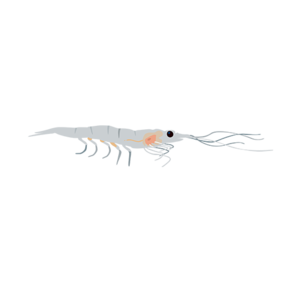
A generic name for small cold-water crustaceans, krill form the basis of numerous food chains in ocean ecosystems.
Feeding on algae that form under pack ice, their numbers have plummeted in recent years as a result of global warming.
This fish lives in coastal coral reefs.
Its dorsal fin extends into a very long filament. This fish is typically found in coral reefs of the Indian Ocean.
In Polynesia, it is revered, and released when caught.

This animal is very attached to its territory, and is mainly nocturnal. It spends the day in a hole. It can live for almost 50 years! Every summer, lobsters migrate to breed.

Although often confused with the seagull, they are two completely different birds.
Depending on what food is available, it can be both omnivorous and carnivorous. Thanks to its adaptability, its population increased dramatically in the 20th century. This sometimes negatively impacts the environment, so local population control measures may be taken, like egg sterilisation.

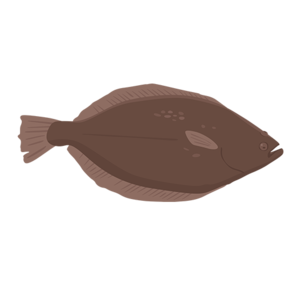
This species consists of flatfish with both eyes on the same side, the right, the left side being blind and unpigmented because it faces the ground. The Atlantic halibut is more commonly known as white halibut. It lives at depths of over 150 m, but can descend to over 500 m in winter, coming higher again in summer.
Exocet (like the missile) is the French name for this fish. Its highly-developed fins enable it to leap high out of the water to escape predators like tuna.
It grows to around 20 cm and feeds on plankton and crustaceans.
Flying fish sometimes land on the Vendée Globe boats!

This can grow up to 30 metres long and weigh up to 200 metric tons!
Its mouth is equipped with baleen plates, and it feeds mainly on krill and small shoals of fish. Whaling almost caused its extinction. This practice has been banned since 1986. Vendée Globe skippers sometimes come across them, and must take care not to hit one!
Do you know ?
The blue whale is an endangered species.

Also known as the great albatross, it is the largest and heaviest member of the albatross family, with a wingspan of around 3.5 m. It spends almost 95% of its life in flight. It has developed a "dynamic gliding" technique: to avoid exhaustion, it hardly ever flaps its wings.

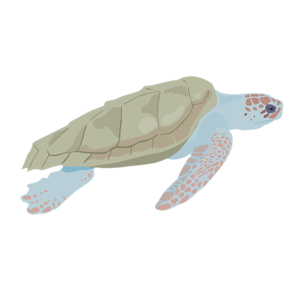
Also known as the green turtle, it is widespread in the south-western Indian Ocean, so skippers often come across them. The green turtle’s name is due to the colour of its flesh, not its shell, as it is a herbivore.
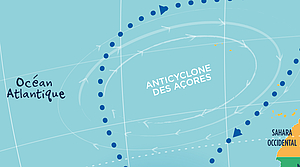
An anticyclone is an area of high pressure. When the pressure rises above 1015 hPa (hectoPascal), this heralds fine weather.
Under the effect of this increased pressure, the winds drop, fostering the arrival of better weather, but this is not necessarily helpful for speed.
The Doldrums are a zone dreaded for its changeable climate. Also known as the Intertropical Convergence Zone (ITCZ), the Doldrums encircle the Earth at the Equator. Skippers thus cross them twice during their round-the-world voyage.
As they approach this zone, the trade winds, which carry yachts with south-westerly winds in the northern hemisphere and north-westerly winds in the southern hemisphere, suddenly rise vertically, depriving sailors of horizontal wind.
This is a very unstable area: in very calm seas, the winds can suddenly become violent and bring torrential rain as well.
Particularly unstable and energetic, the Saint Helena High forces skippers to sail well off the coast of Africa.
The skippers' goal is to get as close as possible to the anticyclone to “capture” the anti-clockwise winds without getting trapped in this large zone of high pressure, which can cause major delays.

Do you know ?
St Helena is also an island at the heart of the anticyclone, 2,000 kilometres from the African coast and over 3,000 kilometres from Brazil. It was home to a very famous Frenchman: Napoleon I, who was exiled here in 1815 until his death in 1821.
Between the 40th and 50th parallels in the Southern Hemisphere, all around Antarctica, there are no obstacles or continents to impede a crazy series of depressions created by the meeting of warm and cold air. This area is known for its strong winds and raging seas.
These lows create impressive waves, increased by the force of winds blowing continuously over very long distances. This area is dreaded by skippers for its storms and fearsome waves.

This is a climatic anomaly that occurs every 3 to 7 years. The name "El Niño", meaning "baby Jesus" in Spanish, comes from the fact that this event occurs at Christmas in Peru. El Niño is a warm sea current that heats up the waters off the coasts of Chile and Peru and prevents the "normal" rising of deep cold water.
Consequences :
- The warm water prevents plankton from reproducing, and fish become scarce and die. This leads to frequent famines in coastal countries
- The northern part of South America experiences severe drought, while torrential rains fall on the west coast of South America.
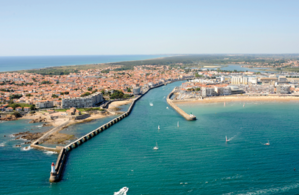
The port of Les Sables d’Olonne consists of several basins: fishing, yachting and commercial. A village is set up in Port Olona for the Vendée Globe. This is the town's marina.
Although the Bay of Biscay more accurately describes a geographical area lying between southern Brittany and the north-western tip of Spain, it is home to a phenomenon of low pressure known as atmospheric lows, which can bring severe gales, impressive breaking swells and sustained rainfall.
The Bay of Biscay, combined with fairly heavy shipping, is the skippers' first pitfall in terms of weather.
The equator is an imaginary line that encircles the earth at its widest point. It measures around 40,075 km. It marks the separation between the northern and southern hemispheres. The equator is the same distance from the North and South poles.

Do you know ?
Crossing the equator, known as “crossing the line”, is a tradition all sailors cherish. In crews, when a sailor crosses the equator for the first time, he is knocked about by his mates and they make offerings to Neptune, king of the seas. It's a moment of celebration, like an initiatory ritual. Newcomers to the Vendée Globe carry on the tradition all by themselves!
This is one of the most dangerous capes in the world because of the violent winds and the opposing currents of the Atlantic and Indian Oceans. For the Vendée Globe sailors, rounding this cape symbolises their entry into the cold, rough seas in the southern part of the planet.

Do you know ?
In 1488, a Portuguese explorer, Bartolomeu Dias, attempted to sail south around the African coast to find a sea route to India. Near the southernmost part of the continent, the fleet was caught in a storm blowing towards the coast at Sainte-Blaise Bay (now Mossel Bay), 370 km east of the tip of South Africa. Bartholomeu Dias realised that they had passed the Cape of Good Hope without seeing it, and were now in the Indian Ocean. He decided to continue exploring, but his crew rebelled. Turning back, he recognised the point and named it the Cape of Storms. Later, to avoid frightening sailors, it was given a new name: the Cape of Good Hope.
CThis discovery was crucial, as it proved that there was a sea route to India.
In this very southerly zone, a particular danger lies in wait for sailors: icebergs – blocks of ice that break away from the continent – and growlers, pieces of ice that float on the surface and are difficult to spot on a radar. To minimise the danger to competitors, the race management has set up an Antarctic Exclusion Zone: an imaginary line (made up of 72 points according to the position of the ice during the race) that skippers are forbidden to cross, thus ensuring they do not get too close to Antarctica and these invisible dangers.
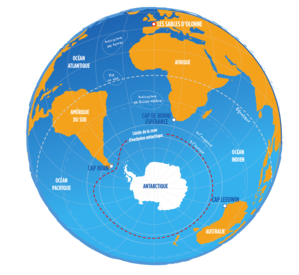
Located at the south-western tip of Australia, Cape Leuuwin is very far north of the route taken by the skippers. It is not, as is often thought, the gateway to the Pacific, which begins south of Tasmania. During the race, this cape marks the definitive entry into the Southern Ocean with its extreme weather conditions. It’s rather like starting the climb to the very top of Mount Everest!

Do you know ?
This cape owes its name to the Dutch galleon Leeuwin (lioness in Flemish), which discovered it in 1622.
The Nemo Point, or the “Maritime Pole of Inaccessibility”, is the point in the ocean furthest from any land, the nearest island being 2,688 kilometres away.
Do you know ?
This point owes its name to Captain Nemo, the famous character from Jules Verne's novel Twenty Thousand Leagues Under the Sea. Nemo is the Latin for "nobody".
The strong winds and powerful waves of this region account for the Horn’s infamous reputation as the deadliest shipping lane in the world.
Rounding Cape Horn is a reason for celebrating on board. Because for the Vendée Globe skippers, the hardest part is over, with no more icebergs, polar conditions, gloves, hats, etc. To double this cape, they have had to descend as far as possible, sail along the 60th parallel and head north, where the sea warms up and the winds die down. This is the final stretch before the finish. But be warned: anything can still happen!

Do you know ? />The cape is named after a town in the Netherlands. Jacques Lemaire, Guillaume Schouten and their crew set sail from the port of Horn in the Netherlands on 16 May 1615 and reached Cape Horn for the first time on 31 January 1616. They named it after their home port.